November 25, 2026
Life is better together
Ecclesiastes 4:9-12; Hebrews 10:19-25

Teish Ngoi
Key Verse | Ecclesiastes 4:9
Two are better than one, because they have a good reward for their toil.
Today's Focus
Liturgy
Liturgy is a historic approach to worship that emphasizes shared rhythms, intentional structure, and repeated practices. The original Greek word refers to “service” or “public work,” and over time it came to describe the ordered patterns of Christian worship (The Oxford Dictionary of the Christian Church, Cross and Livingstone). Liturgy can refer to the flow of a worship service or to specific practices within it, such as the Eucharist (Communion or the Lord’s Supper).
At its heart, liturgy is designed to direct our attention toward God, helping worshipers return again and again to the central truths of the faith. Through repeated prayers, Scripture, and practices, liturgy forms our hearts by reminding us of what matters most—Jesus himself. These rhythms can shape corporate worship, such as a weekly Sunday service, and they can also be practiced personally, as individuals establish meaningful patterns of worship in everyday life.
Ecclesiastes 4:9-12; Hebrews 10:19-25
9 Two are better than one, because they have a good reward for their toil. 10 For if they fall, one will lift up his fellow. But woe to him who is alone when he falls and has not another to lift him up! 11 Again, if two lie together, they keep warm, but how can one keep warm alone? 12 And though a man might prevail against one who is alone, two will withstand him—a threefold cord is not quickly broken.
Table of Contents
Introduction to Ecclesiastes
Timeline

Author
The author of Ecclesiastes calls himself “the Preacher” (1:1). Some interpreters have concluded that this was Solomon, while others think he was a role-playing writer later than Solomon. Either way, the book claims that its wisdom comes from the “one Shepherd” (12:11), the Lord himself.
Theme and Interpretation of Ecclesiastes
The theme of Ecclesiastes is the necessity of fearing God in this fallen, confusing world. Each human being wants to understand all the ways God is acting in the world, but he cannot, because he is not God. And yet the faithful do not despair but cling to God, even when they cannot see what God is doing. The Lord deserves his people’s trust. They can leave everything to him while they seek to understand what it means to “fear God and keep his commandments” (12:13). This is true wisdom.
Key Themes
- The tragic reality of the fall. The Preacher is painfully aware that the creation has been damaged by sin (7:29; Rom. 8:20, 22). He speaks as one who eagerly awaits the resurrection age (Rom. 8:23).
- The “vanity” of life. The book begins and ends with the exclamation, “Vanity of vanities! All is vanity” (Eccles. 1:2; 12:8). The phrase pictures something fleeting and elusive. All the endeavors and pleasures of earthly life are only temporary. When one sees the consequences of sin in this fallen world, one is left in utter frustration, anger, and sorrow. The more one tries to understand life, the more mysterious it becomes (1:12–18).
- Sin and death. By sinning, human beings forfeited the righteousness they originally had before God (7:29), and thus all people are sinners (7:20). Death was a result of the fall. The Preacher is only too aware of this dreadful reality that affects everyone (e.g., 2:14–17; 3:18–21; 6:6).
- The joy and the frustration of work. God gave Adam work to accomplish prior to the fall, but part of the punishment of his sin was that his work would become difficult (Gen. 2:15; 3:17–19). Both realities are seen in the Preacher’s experience, as he finds his work to be both satisfying (Eccles. 2:10, 24; 3:22; 5:18–20; 9:9–10) and aggravating (2:18–23; 4:4–8).
- The grateful enjoyment of God’s good gifts. The Preacher spends a great deal of time commenting on the twisted realities of a fallen world, but this does not blind him to the beauty of God’s world (3:11). Nor does it cause him to despise God’s good gifts of human relationships, food, drink, and satisfying labor (5:18–20; 8:15; 9:7, 9). These are to be received humbly and enjoyed fully as blessings from God.
- The fear of God. The fact that “all is vanity” should drive people to take refuge in God, fearing and revering him (7:18; 8:12–13; 12:13–14).
Outline
- Introduction and Theme (1:1–3)
- First Catalog of “Vanities” (1:4–2:26)
- Poem: A Time for Everything (3:1–8)
- Fear God, the Sovereign One (3:9–15)
- Second Catalog of “Vanities” (3:16–4:16)
- Fear God, the Holy and Righteous One (5:1–7)
- Life “Under the Sun” (5:8–7:24)
- The Heart of the Problem: Sin (7:25–29)
- More on Life “Under the Sun” (8:1–12:7)
- Final Conclusion and Epilogue (12:8–14)
Fact: Ecclesiastes
Ecclesiastes encourages God’s people to trust him in a fallen and often confusing world, in which sin and heartache touch every corner of the globe. We are to “fear God and keep his commandments” (12:13), even when we cannot understand everything that is going on around us.
Fact: Vanity, vanities, and vain
The words vanity, vanities, and vain occur nearly 40 times in Ecclesiastes. Their literal meaning is “vapor” or “breath,” so they are used to describe things that can be fleeting or elusive, like the search for meaning and purpose in life.
Fact: “Eat, drink, and be merry”?
“Eat, drink, and be merry”? Ecclesiastes advises those who serve God to enjoy his gifts of food, drink, comfort, married life, and honest work (9:7–9; compare 2:24–26; 3:13; 5:19–20).
Eccles. 4:7–11 Some people engage in endless toil yet are never satisfied even though they acquire great riches. On the other hand there are those who give up their jealous desires to always be the best; they discover that two are better than one as they share their work load, enjoying a good reward and finding help in hard times.
Eccles. 4:12 A threefold cord stands for the great value of being part of a larger group rather than being alone.
Two are better than one
In a world that celebrates independence, God reminds us that we were made for one another. We’re often encouraged to be self-sufficient: build your life, protect your peace, and need as little from others as possible. But Scripture gives us a different picture.
In Ecclesiastes, the author explores life “under the sun,” considering the human experience from an earthly perspective. As he wrestles with life’s uncertainty and how quickly it passes, he comes to a simple conclusion: two are better than one.
Life together isn’t just easier. According to God's design, it’s better. We can strengthen one another when we’re weak, offer comfort when we’re hurting, and help each other see what we might miss on our own. God gives us something through community that we can’t provide for ourselves: the strength, perspective, and encouragement of others.
This isn’t just practical advice. It’s deeply connected to the gospel.
Hebrews 10 begins by reminding us of what Jesus has accomplished through his sacrifice. Because of Christ, we can now draw near to God with confidence. Yet the writer doesn’t stop with our relationship to God. He goes on to say, “Let us consider how to stir one another up to love and good works,” and urges believers not to neglect meeting together (Hebrews 10:24-25).
There’s an intentional connection between these instructions. Love doesn’t grow in isolation. As Theodore H. Robinson writes in The Epistle to the Hebrews, “Love needs stimulation and society; the exercise of love is possible only in community.”
In other words, we need one another to grow in love. We need people who encourage us when we’re weary, challenge us when we become complacent, and remind us of what’s true. And just as others do this for us, we’re called to do the same for them.
The gospel doesn’t just bring us into the presence of God. It brings us into a people.
Following Jesus was never meant to be something we do alone. Let’s not miss the gift God has given us in one another. As we bear each other’s burdens, encourage one another in faith, and walk alongside one another, God uses community to make us more like Christ.
Respond in Community
- Examine your heart. Set a timer for 5, 10, or 15 minutes and sit quietly before God. Consider where self-sufficiency and independence have shaped the way you relate to God and others. Ask God to show you where you’ve resisted receiving help, care, or encouragement.
- Confess and pray for one another. When the timer goes off, share what God brought to mind. Confess the ways you’ve tried to carry life on your own, and embrace the humility of being known by others. Then pray for one another, asking God to help you live in greater dependence on him and his people.
- Encourage one another. Hebrews 10:24 calls us to “stir one another up to love and good works.” Take time to speak life over one another. What do you see God doing in this person? Where have you seen their faithfulness, growth, or strength? Encourage them specifically.
- Pray the Lord’s Prayer together. Notice the language: our Father, our daily bread, our debts. Even our prayers teach us that we belong together. Pray slowly, remembering that through Christ, you’ve not only been brought near to God, but also brought into his people.
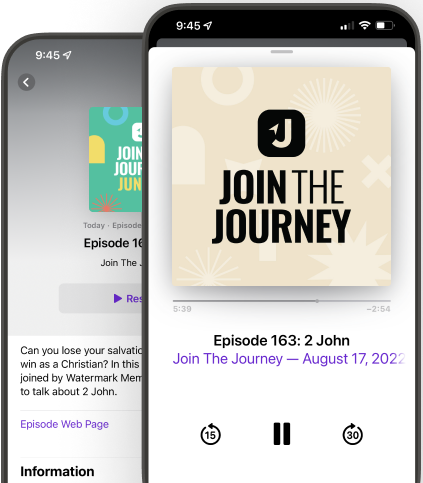
Watch or listen to the podcast
Tuesdays and Wednesdays
Monthly memory verse
There is one body and one Spirit—just as you were called to the one hope that belongs to your call— one Lord, one faith, one baptism, one God and Father of all, who is over all and through all and in all.