July 20, 2026
Paul and Silas take a trip to prison
Acts 16:16-40
Paul Muncy
Key Verse | Acts 16:16
As we were going to the place of prayer, we were met by a slave girl who had a spirit of divination and brought her owners much gain by fortune-telling.
Today's Focus
Observation
Observation answers the question: “What does the text say?” It’s slowing down and noticing the details before determining what the text means. To observe, first ask who, what, when, where, why, and how questions about the passage you’re studying. (e.g. “Who is speaking, being spoken to, or might be nearby listening?”) Every answer should be backed up by a verse reference, and your answers shouldn’t be guesses or inferences—they’re simply observations. Answering these questions can also mean, reading the passage slowly, looking for keywords, repetition, comparison, contrast, relationships, general/specific, word order, patterns, or any other details.
Acts 16:16-40
Paul and Silas in Prison
16 As we were going to the place of prayer, we were met by a slave girl who had a spirit of divination and brought her owners much gain by fortune-telling. 17 She followed Paul and us, crying out, “These men are servants of the Most High God, who proclaim to you the way of salvation.” 18 And this she kept doing for many days. Paul, having become greatly annoyed, turned and said to the spirit, “I command you in the name of Jesus Christ to come out of her.” And it came out that very hour.
19 But when her owners saw that their hope of gain was gone, they seized Paul and Silas and dragged them into the marketplace before the rulers. 20 And when they had brought them to the magistrates, they said, “These men are Jews, and they are disturbing our city. 21 They advocate customs that are not lawful for us as Romans to accept or practice.” 22 The crowd joined in attacking them, and the magistrates tore the garments off them and gave orders to beat them with rods. 23 And when they had inflicted many blows upon them, they threw them into prison, ordering the jailer to keep them safely. 24 Having received this order, he put them into the inner prison and fastened their feet in the stocks.
The Philippian Jailer Converted
25 About midnight Paul and Silas were praying and singing hymns to God, and the prisoners were listening to them, 26 and suddenly there was a great earthquake, so that the foundations of the prison were shaken. And immediately all the doors were opened, and everyone's bonds were unfastened. 27 When the jailer woke and saw that the prison doors were open, he drew his sword and was about to kill himself, supposing that the prisoners had escaped. 28 But Paul cried with a loud voice, “Do not harm yourself, for we are all here.” 29 And the jailer 1 16:29 Greek he called for lights and rushed in, and trembling with fear he fell down before Paul and Silas. 30 Then he brought them out and said, “Sirs, what must I do to be saved?” 31 And they said, “Believe in the Lord Jesus, and you will be saved, you and your household.” 32 And they spoke the word of the Lord to him and to all who were in his house. 33 And he took them the same hour of the night and washed their wounds; and he was baptized at once, he and all his family. 34 Then he brought them up into his house and set food before them. And he rejoiced along with his entire household that he had believed in God.
35 But when it was day, the magistrates sent the police, saying, “Let those men go.” 36 And the jailer reported these words to Paul, saying, “The magistrates have sent to let you go. Therefore come out now and go in peace.” 37 But Paul said to them, “They have beaten us publicly, uncondemned, men who are Roman citizens, and have thrown us into prison; and do they now throw us out secretly? No! Let them come themselves and take us out.” 38 The police reported these words to the magistrates, and they were afraid when they heard that they were Roman citizens. 39 So they came and apologized to them. And they took them out and asked them to leave the city. 40 So they went out of the prison and visited Lydia. And when they had seen the brothers, they encouraged them and departed.
Table of Contents
Introduction to Acts
Timeline

Author and Date
Acts is a sequel to the Gospel of Luke. Both were written by Luke, a physician who traveled with the apostle Paul. Acts ends with Paul under house arrest, awaiting trial before Caesar, c. A.D. 62. Many scholars assume Acts was written then because it does not record Paul’s defense, release, and further gospel preaching.
Theme
The Holy Spirit empowers believers to declare the gospel among both Jews and Gentiles. In doing so they establish the church. The church is the fulfillment of God’s promises from the beginning of time.
Purpose
Luke’s purpose for writing his Gospel (see Luke 1:3–4) applies to Acts as well: to give an “orderly” account of the early church after Christ’s resurrection. Dedicating the two-volume work to Theophilus, Luke wanted him to have “certainty” about what he had been taught.
Key Themes
Acts tells of the witness of the early church to the truth of the gospel—a theme first introduced in 1:8:
- The witness is worldwide—Judea, Samaria, the “end of the earth” (1:8).
- The witness includes all kinds of people (chs. 2–5; 10:1–11:18; 14:8–18; 16:11–15, 25–34; 17:22–31).
- God guides the church’s witness (4:5–22; 23:12–22; 24:1–23; 27:21–26).
- Faithful witnesses must be prepared to suffer and even die because of their testimony to Christ (5:41–42; 7:54–60).
- The Holy Spirit empowers the witness (1:8; 2:1–13; 8:17; 13:2–12; 19:6).
- Effective witness demands unity in the church (2:42–47; 4:32–37; 5:12–14).
- Jesus’ resurrection is a key part of the witness (1:22; 2:22–36; 17:30–31).
- Acceptance of the message depends both on human response and on God’s sovereign will (2:47; 11:18; 13:48).
- The witness to the gospel calls for a response (26:27–29). It requires repenting of one’s sins in the name of Christ. This brings forgiveness of sins (e.g., 2:38).
- Witnesses must always maintain integrity before the world (18:12–15; 23:29; 25:18; 26:31–32).
- Christian witnesses continue the ministry that Christ “began” (1:1).
- Faithful witness can bring great results (4:4; 13:48–49; 17:4; 28:30–31).
Outline
- Preparation for Witness (1:1–2:13)
- The Witness in Jerusalem (2:14–5:42)
- The Witness beyond Jerusalem (6:1–12:25)
- The Witness in Cyprus and Southern Galatia (13:1–14:28)
- The Jerusalem Council (15:1–35)
- The Witness in Greece (15:36–18:22)
- The Witness in Ephesus (18:23–21:16)
- The Arrest in Jerusalem (21:17–23:35)
- The Witness in Caesarea (24:1–26:32)
- The Witness in Rome (27:1–28:31)
The Setting of Acts

Fact: Who wrote Luke?
Who wrote Luke? Luke wrote both this Gospel account and Acts. He probably traveled with Paul and participated in his ministry (see Col. 4:14; 2 Tim. 4:11; Philem. 24). Luke was also a physician (Col. 4:14).
Fact: The speeches in Acts
The speeches in Acts are an important part of Luke’s historical account. They make up nearly a third of the book. Ten of these are extended speeches: three by Peter, one by Stephen, and six by Paul.
Fact: Ananias
Ananias. There are three different men named Ananias in the book of Acts (see 5:1; 9:10; 24:1). The Ananias who was apparently the first believer to welcome Paul after his conversion is a positive example of obedience to the Lord (9:10–19).
Fact: What is “the Way?”
What is “the Way?” In Acts, “the Way” appears six times (9:2; 19:9, 23; 22:4; 24:14, 22). People who belonged to the Way were followers of Christ. It means the way of salvation (16:17) and/or the true way of life in relation to God (see 18:25–26).
Fact: What happens next?
What happens next? Acts ends with Paul serving Christ from within a Roman prison. During this time, he wrote Ephesians, Philippians, Colossians, and Philemon. According to the church historian Eusebius, Paul was released, then arrested a second time, and eventually martyred in Rome.
Fact: Philippi
Philippi was founded by the Greek king Philip II, father of Alexander the Great, in 356 B.C. Some 300 years later, in 42 B.C., it was in Philippi that Augustus Caesar defeated Brutus and Cassius after they had assassinated Julius Caesar. But the most significant event to occur in Philippi is recorded in 16:6–15, when Paul came to Philippi, making it the first European city to hear the Good News from this great ambassador of Christ.
The Setting of 1 Timothy
c. A.D. 62–64
Paul likely wrote 1 Timothy during a fourth missionary journey not recorded in the book of Acts. Writing from an unknown location, Paul wrote to Timothy at Ephesus to instruct him on how to lead the church there. Ephesus was a wealthy and highly influential port city in the Roman province of Asia, renowned for its temple of Artemis (Diana).

The Setting of 2 Timothy
c. A.D. 64–67
Paul probably wrote 2 Timothy during a second imprisonment in Rome following a fourth missionary journey that is not recorded in Acts. Expecting that death would come soon, Paul wrote this “farewell” letter to Timothy, who was at Ephesus, urging him to stand firm and asking him to come for one final visit.

The Setting of Titus
c. A.D. 62–64
Paul likely wrote Titus during a fourth missionary journey not recorded in the book of Acts. Writing from an unknown location, he instructed Titus in how to lead the churches on the island of Crete. The churches there had apparently been founded by Paul.

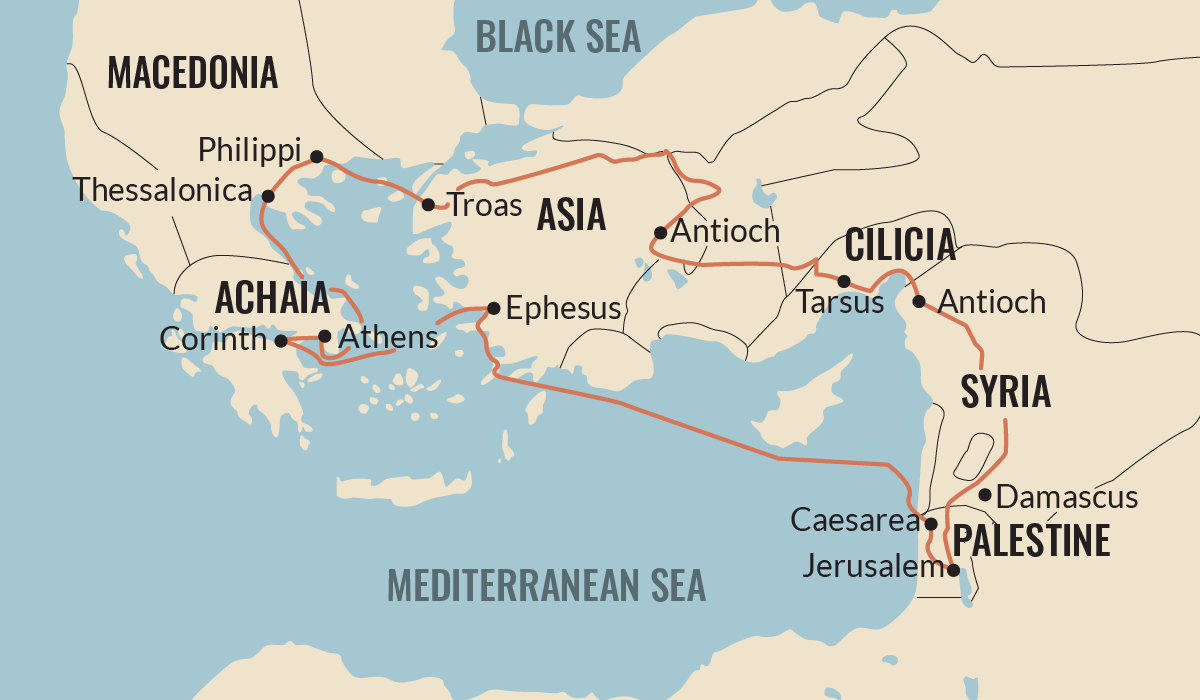
Paul’s Second Missionary Journey (Acts 15:36–18:22)
c. A.D. 49–51
Paul and Silas revisited the places in Asia Minor where Paul had preached on his first journey (see map), while Barnabas took John Mark and sailed to Cyprus. Paul and Silas visited Derbe, Lystra, and Antioch in Pisidia. From there Paul and Silas traveled to Troas, where Paul received a vision of a man from Macedonia calling to them. Crossing into Europe, they passed through several towns along the Egnatian Way and traveled to the cities of Athens and Corinth in southern Greece. Then, sailing to Ephesus and Caesarea, they visited the church in Jerusalem before returning to Antioch of Syria.

New Testament Timeline
The following chart provides a detailed New Testament timeline. Most of the dates can be determined precisely by correlating biblical events with extensive historical documents and archaeological evidence. Dates with an asterisk denote approximate or alternative dates. The extensive external confirmation of New Testament dates and events encourages great confidence in the truth and historicity of both the Old and New Testaments.
| 5 B.C.* | Jesus is born in Bethlehem. |
| 4 B.C. | Jesus’ family flees to Egypt to escape from Herod’s plan to kill Jesus (Matt. 2:13–18); Herod dies; Judas (of Sepphoris) and others rebel, requiring the Syrian Governor Varus to intervene throughout Palestine; Sepphoris, a city four miles from Nazareth, is destroyed by Roman soldiers; Judea, Samaria, and Idumea are given to Herod’s son, Archelaus; Galilee and Perea are given to his son Antipas; Jesus’ family, after returning from Egypt, resides in Nazareth (Matt. 2:19–23), a small village in southern Galilee. |
| A.D. 6 | Archelaus is exiled for incompetence; Judea becomes a Roman province; Judas the Galilean (of Gamla) leads a revolt against the tax census; the governor of Syria, Quirinius (A.D. 6–7), appoints Annas high priest (6–15). |
| 8* | Jesus (age 12) interacts with the teachers in the temple (Luke 2:41–50). |
| 8*–28/30 | Jesus works as a carpenter in Nazareth (Matt. 13:55; Mark 6:3) and probably in neighboring villages and Sepphoris, which was being rebuilt. |
| 28–29* | John the Baptist begins his ministry around the Jordan River (John 1:19). |
| 28–30* | Jesus begins his ministry in Judea, but soon focuses his efforts in Galilee. In Jerusalem, Pharisees (like Gamaliel) train disciples (like Paul) in their tradition. They send a delegation to Galilee, but the delegation rejects Jesus’ teaching. In Alexandria, Philo (20 B.C.–A.D. 50) attempts to unify Greek philosophy with Hebrew Scripture. |
| 33 (or 30) | Jesus returns to Judea, is crucified, and resurrected. James the brother of Jesus becomes a believer after witnessing the resurrected Jesus (1 Cor. 15:7; Acts 12:17). Jesus ascends to the Father’s right hand (Acts 1). Jesus’ first followers receive the Holy Spirit at Pentecost and begin to proclaim the gospel (Acts 2). |
| 33/34* | Paul witnesses the resurrected Lord on the way to Damascus and is commissioned as an apostle to the nations (Acts 9; Gal. 1:15–16). |
| 34–37 | Paul ministers in Damascus and Arabia (Acts 9:19–22; 26:20; Gal. 1:16–18). |
| 36 | Pilate loses his position for incompetence. |
| 36/37* | Paul meets with Peter in Jerusalem (Acts 9:26–30; Gal. 1:18). |
| 37–45 | Paul ministers in Syria, Tarsus, and Cilicia (Acts 9:30; Gal. 1:21). |
| 38* | Peter witnesses to Cornelius (Acts 10). |
| 39 | Antipas is exiled. |
| 40–45* | James writes his letter to believers outside Palestine (see James 1:1). |
| 41–44 | Agrippa, Herod the Great’s grandson, rules Palestine; he kills James the brother of John (Acts 12:2) and imprisons Peter (Acts 12:3). |
| 42–44 | Paul receives his “thorn in the flesh” (2 Cor. 12:7). |
| 44 | Peter leaves Jerusalem; Agrippa is killed by an “angel of the Lord” (Acts 12:23). |
| 44–46 | Theudas persuades many Jews to sell their possessions and follow him into the wilderness where he claimed he would miraculously divide the Jordan River; Roman procurator Fadus dispatches his cavalry and beheads the would-be messiah. |
| 44–47* | Paul’s Second Visit to Jerusalem; time of famine (Acts 11:27–30; Gal. 2:1–10). |
| 46–47 | Paul’s First Missionary Journey (with Barnabas) from Antioch to Cyprus, Antioch in Pisidia, Iconium, and Lystra (Acts 13:4–14:26). |
| 46–48 | Roman procurator Tiberius Alexander crucifies two sons (Jacob and Simon) of Judas the Galilean. |
| 48* | Paul writes Galatians, perhaps from Antioch (see Acts 14:26–28). |
| 48–49* | Paul and Peter return to Jerusalem for the Apostolic Council, which, with the assistance of James, frees Gentile believers from the requirement of circumcision in opposition to Pharisaic believers (Acts 15:1–29); Paul and Barnabas return to Antioch (Acts 15:30) but split over a dispute about John Mark (Acts 15:36–40). |
| 48/49–51* | Paul’s Second Missionary Journey (with Silas) from Antioch to Syria, Cilicia, southern Galatia, Macedonia, notably Philippi, Thessalonica, and Berea; and then on to Achaia, notably Athens and Corinth (Acts 15:36–18:22). |
| 49 | Claudius expels Jews from Rome because of conflicts about Jesus (Acts 18:2); Paul befriends two refugees, Priscilla and Aquila, in Corinth (Acts 18:2–3). |
| 49–51* | Paul writes 1–2 Thessalonians from Corinth (Acts 18:1, 11; also compare Acts 18:5 with 1 Thess. 1:8). |
| 51 | Paul appears before Gallio, proconsul of Achaia (Acts 18:12–17). |
| 50–54* | Peter comes to Rome. |
| 52–57* | Paul’s Third Missionary Journey from Antioch to Galatia, Phrygia, Ephesus, Macedonia, Greece (Acts 18:23–21:17). |
| 52–55 | Paul ministers in Ephesus (Acts 19:1–20). |
| 53–55* | Mark writes his Gospel, containing Peter’s memories of Jesus; perhaps within a decade, Matthew publishes his Gospel, which relies on Mark and other sources. Paul writes 1 Corinthians from Ephesus (Acts 19:10). |
| 54 | Claudius dies (edict exiling Jews repealed); Priscilla and Aquila return to Rome and host a church in their home (see Rom. 16:3–5). |
| 54–68 | Nero reigns. |
| 55–56* | Paul writes 2 Corinthians from Macedonia (Acts 20:1, 3; 2 Cor. 1:16; 2:13; 7:5; 8:1; 9:2, 4; see 1 Cor. 16:5). |
| 57* | Paul winters in Corinth and writes Romans (Acts 20:3; see Rom. 16:1–2; also see Rom. 16:23 with 1 Cor. 1:14); travels to Jerusalem (Acts 21:1–16), visits with James the brother of Jesus (Acts 21:17–26), and is arrested (Acts 21:27–36; 22:22–29). |
| 57–59 | Paul is imprisoned and transferred to Caesarea (Acts 23:23–24, 33–34). |
| 60 | Paul begins voyage to Rome (Acts 27:1–2); he is shipwrecked for three months on the island of Malta (Acts 27:39–28:10). |
| 60–70* | Letter to the Hebrews is written. |
| 62 | James the brother of the Lord is executed by the Sadducean high priest Ananus. |
| 62–63* | Peter writes his first letter (1 Peter) from Rome (1 Pet. 5:13). |
| 62* | Paul arrives in Rome and remains under house arrest (Acts 28:16–31); he writes Ephesians (see verses for Colossians), Philippians (Phil. 1:7, 13, 17; 4:22), Colossians (Col. 4:3, 10, 18; see Acts 27:2 with Col. 4:10), Philemon (see Philem. 23 with Col. 1:7; Philem. 2 with Col. 4:17; Philem. 24 with Col. 4:10; also see Col. 4:9). Luke, Paul’s physician and companion (see Col. 4:14), writes Luke and Acts. |
| 62–64 | Paul is released, extends his mission (probably reaching Spain), writes 1 Timothy from Macedonia (see 1 Tim. 1:3) and Titus from Nicopolis (Titus 3:12); he is rearrested in Rome (2 Tim. 1:16–17). |
| 63–64 | Work on the temple complex is completed. |
| 64 (July 19) | Fire in Rome; Nero blames and kills many Christians. |
| 64–67* | Peter writes his second letter ( 2 Peter). Jude writes his letter. Paul writes 2 Timothy (see 2 Tim. 4:6–8). Paul and Peter are martyred in Rome. |
| 66 | First Jewish-Roman War begins with a riot between Greeks and Jews at Caesarea; Roman procurator Gesius Florus (A.D. 64–66) is murdered and a Roman garrison wiped out; Menahem, son or grandson of Judas the Galilean, murders the high priest Ananias and seizes control of the temple; Nero dispatches Vespasian with three legions. |
| 67* | Romans destroy the Qumran community, who beforehand hid the so-called Dead Sea Scrolls in nearby caves; the church in Jerusalem flees to Pella (Matt. 24:15–16; Mark 13:14; Luke 21:20–22); John migrates to Ephesus with Mary, Jesus’ mother. |
| 68 | Nero commits suicide; year of the three emperors. |
| 69 | Rebellion quelled in Galilee and Samaria; Vespasian summoned back to Rome to become emperor. |
| 70 (Aug. 30) | Titus, Vespasian’s son, after a five-month siege of Jerusalem, destroys the temple after desecrating it; the temple’s menorah, Torah, and veil are removed and later put on display in a victory parade in Rome; the influence of the Sadducees ends; the Pharisee Johanan ben Zakkai escapes and convinces the Romans to allow him and others to settle in Jamnia, where they found a school. |
| 73 (May 2)* | Before Roman general Silva breaches the fortress atop Masada following a two-year siege, 936 Jewish rebels commit suicide. |
| 75 | Titus has an affair with the Jewish princess Berenice, sister of Agrippa II (Acts 25:13, 23), whom he later abandons because of the scandal. |
| 77 | Pliny the Elder writes Natural History. |
| 77–78 | Josephus publishes Jewish War in Rome. |
| 79 | Pompeii and Herculaneum are destroyed by eruption of Vesuvius; Pliny the Elder dies attempting to investigate. |
| 81 | The Arch of Titus, celebrating his destruction of the temple, is erected in Rome. |
| 81–96 | Domitian, Titus’s brother, persecutes Christians among the Roman nobility, including his own relatives Clemens and Domitilla. |
| 85–95* | John writes his letters (1–3 John), probably in Ephesus. |
| 89–95* | John writes his Gospel, probably in Ephesus. |
| 93–94 | Josephus publishes Jewish Antiquities in Rome. |
| 94 | Domitian exiles philosophers from Rome. |
| 95* | Amidst persecution, Clement, a leader in the Roman church, writes his Letter to the Corinthians (1 Clement) appealing for peace between the young men and elders. |
| 95–96* | Exiled by Domitian to Patmos, John writes Revelation (Rev. 1:9). |
| 96–98 | Nerva, the first of five “good” emperors, ends official persecution. |
* denotes approximate date; / signifies either/or
Parallels in the Ministries of Jesus, Peter, and Paul in Luke–Acts
Luke shows Peter and Paul continuing the ministry of Jesus in the book of Acts. Representative examples are cited on the chart below.
| Type of Ministry | Jesus | Peter | Paul |
|---|---|---|---|
| Preaching that the OT is fulfilled in Jesus the Messiah | Luke 4; 24 | Acts 2; 3 | Acts 13; 17 |
| Casting out unclean spirits | Luke 4:31–37 | Acts 5:16 | Acts 16:16–18 |
| Healing the lame | Luke 6:6–11 | Acts 3:1–10 | Acts 14:8–10 |
| Raising the dead | Luke 7:11–17 | Acts 9:36–43 | Acts 20:7–12 |
| Healing by a touch, a shadow, or cloths | Luke 8:42–48 | Acts 5:15 | Acts 19:11–12 |
God’s Sovereignty in Salvation as Seen in Acts
| God ordained the cross | God calls, adds, and appoints many to eternal life | God gives faith and repentance; God cleanses and opens hearts |
|---|---|---|
|
2:23 “Jesus, delivered up according to the definite plan and foreknowledge of God”
3:18 “what God foretold by the mouth of all the prophets, that his Christ would suffer, he thus fulfilled” 4:27–28 “there were gathered together . . . Herod and Pontius Pilate, along with the Gentiles and the people of Israel, to do whatever your hand . . . had predestined to take place” |
2:39 “the promise is to . . . everyone whom the Lord our God calls to himself ”
2:41 “there were added that day about three thousand souls” 2:47 “the Lord added to their number day by day those who were being saved” 5:14 “believers were added to the Lord, multitudes of both men and women” 11:24 “a great many people were added to the Lord” 13:48 “as many as were appointed to eternal life believed” |
3:16 “the faith that is through Jesus”
5:31 “God exalted him . . . to give repentance to Israel” 11:18 “to the Gentiles also God has granted repentance that leads to life” 15:8–9 “God . . . having cleansed their hearts by faith” 16:14 “The Lord opened her heart to pay attention to what was said by Paul” 18:27 “those who through grace had believed” |
Major Sermons in Acts
| Speaker | Text | Audience |
|---|---|---|
| Peter | 2:14–36 | Jews in Jerusalem |
| 3:11–26 | Jews in Jerusalem | |
| 10:34–43 | Cornelius’s household | |
| Stephen | 7:1–53 | Jews in Jerusalem |
| Paul | 13:16–47 | Jews in Pisidian Antioch |
| 17:22–31 | Greeks in Athens | |
| 20:18–35 | Church elders in Ephesus | |
| 22:1–21 | Jews in Jerusalem | |
| 24:10–21 | Felix and his court | |
| 26:1–29 | Agrippa and his court |
Major Events in the Life of the Apostle Paul
| A.D. 5–10? | Born in Tarsus, an Israelite from the tribe of Benjamin and a Roman citizen (Acts 22:3, 28; Rom. 11:1; Phil. 3:5); raised in either Jerusalem (Acts 22:3?) or Tarsus |
| 15–20? | Trained as a Pharisee by Gamaliel I (Acts 22:3; 26:5; Gal. 1:14; Phil. 3:5–6) |
| 30/33? | Death, resurrection of Christ |
| 31–34 | Present at Stephen’s stoning; persecuted Christians (Acts 7:58; 8:1; 22:4a; 26:9–11; 1 Cor. 15:9; Gal. 1:13; Phil. 3:6) |
| 33/34* | Converted, called, and commissioned on the way to Damascus (Acts 9:1–19; 22:6–11; 26:12–18; Gal. 1:15–16) |
| 33/34–36/37 | Stays in Damascus a short time (Acts 9:19b); leaves for Arabia (2 Cor. 11:32; Gal. 1:17); returns to Damascus (Gal. 1:17; Acts 9:20–22?); escapes through city wall to avoid arrest (Acts 9:23–24; 2 Cor. 11:32–33) |
| 36/37* | Meets with Peter, sees James, in Jerusalem (Acts 9:26–30; Gal. 1:18) Hellenists seek to kill him; flees to Tarsus (Acts 9:28–30; Gal. 1:21) |
| 37–45 | Ministers in Syria/Cilicia (2 Cor. 11:22–27?) |
| 44–47* | Ministers with Barnabas in Antioch (Acts 11:25–26) Second Visit to Jerusalem; time of famine (Acts 11:27–30; Gal. 2:1–10) |
| 46–47 | First Missionary Journey (Acts 13:4–14:26): 1.5 years? |
| 48* | With Barnabas, spends “no little time” in Antioch (Acts 14:28; Gal. 2:11–14); writes Galatians |
| 48–49* | Returns to Jerusalem for the apostolic council (Acts 15); Paul and Barnabas return to Antioch (Acts 15:30–33), but dispute over John Mark causes them to part ways (Acts 15:36–41) |
| 48/49–51* | Second Missionary Journey (Acts 15:36–18:22): 2.5 years? |
| 49 | Paul and Silas travel to southern Galatia through Asia Minor, on to Macedonia (Philippi [1 Thess. 2:2]); Thessalonica [1 Thess. 2:2; Phil. 4:15–16]; and Berea [Acts 17:10–15]), and then to Achaia (Athens [1 Thess. 3:1] and Corinth [2 Cor. 11:7–9]) |
| 49–51* | Spends 1.5 years in Corinth (Acts 18:11); appears before Gallio (Acts 18:12–17); writes 1 and 2 Thessalonians |
| 51 | Returns to Jerusalem? (Acts 18:22) |
| 52–57* | Third Missionary Journey (Acts 18:23–21:17): 5 years? |
| 52 | Travels to Antioch, spends “some time”; travels through Galatia and Phrygia (Acts 18:23) |
| 52–55 | Arrives in Ephesus (Acts 19:1; 1 Cor. 16:8); ministers for three years (Acts 20:31) and writes 1 Corinthians; makes brief, “painful visit” to Corinth (2 Cor. 2:1), then returns to Ephesus and writes “severe letter” (now lost) to Corinth (2 Cor. 2:3–4; 7:8–16) |
| 55–56* | Travels north to Macedonia, meets Titus (Acts 20:1; 2 Cor. 2:12–13); writes 2 Corinthians |
| 57* | Winters in Corinth (Acts 20:2–3; 2 Cor. 9:4), writes to the Romans from Corinth; travels to Jerusalem; is arrested (Acts 21:27–36) |
| 57–59 | Transferred as prisoner to Caesarea, stays for two years (Acts 24:27) |
| 60* | Voyage to Rome; shipwrecked, spends three months on Malta (Acts 28:11); finally arrives in Rome |
| 62* | Under house-arrest in Rome (Acts 28:30–31), writes Ephesians, Philippians, Colossians, Philemon |
| 62–67 | Released from house-arrest in Rome, travels to Spain (?), writes 1 Timothy (from Macedonia?) and Titus (from Nicopolis); is rearrested, writes 2 Timothy from Rome, is martyred |
* denotes approximate date; / signifies either/or
Itinerary of Paul’s Second Journey
| City | Province/Region | Reference |
|---|---|---|
| Antioch | Syria | 15:35 |
| Cilicia | 15:41 | |
| Derbe | Galatia (region of Lycaonia) | 16:1 |
| Lystra | Galatia (region of Lycaonia) | 16:1–5 |
| Asia (region of Phrygia) | 16:6 | |
| Galatia | 16:6 | |
| Troas | Asia (region of Mysia) | 16:7–10 |
| Samothrace | Thrace | 16:11 |
| Neapolis | Macedonia | 16:11 |
| Philippi | Macedonia | 16:12–40 |
| Amphipolis | Macedonia | 17:1 |
| Apollonia | Macedonia | 17:1 |
| Thessalonica | Macedonia | 17:1–9 |
| Berea | Macedonia | 17:10–14 |
| Athens | Achaia | 17:15–32 |
| Corinth | Achaia | 18:1–17 |
| Cenchreae | Achaia | 18:18 |
| Ephesus | Asia | 18:19–21 |
| Caesarea | Palestine | 18:22 |
| Jerusalem? | Palestine | 18:22 |
| Antioch | Syria | 18:22 |
Luke
Luke was a doctor (Col. 4:14) and a faithful companion of Paul, accompanying him on several journeys. He was with Paul throughout his two-year imprisonments in both Caesarea and Rome. He is the author of the Gospel bearing his name and the book of Acts, where he records his travels with Paul. Little else is known about Luke. Most scholars believe that he was a Gentile. This is based in part on the fact that Paul does not include Luke among the “men of the circumcision” who were his fellow workers (Col. 4:10–11). How Luke came to know Christ is not revealed, though his thorough acquaintance with the OT suggests that he may have been a “God-fearer” like Cornelius before becoming a Christian. (Acts 21:1–8)
Silas
Silas was a Judean Christian and a leader in the Jerusalem church. After Paul and Barnabas parted ways, Silas joined Paul as a coworker on his second missionary journey. While in Philippi, Paul cast out a spirit that was enabling a girl to tell fortunes (ch. 16). The girl’s owners were furious, since they had been making money from her demonic powers. They brought Paul and Silas before the magistrates, and they were flogged and jailed. Paul and Silas were miraculously freed from their bonds—but rather than flee, they saw an opportunity to share the gospel. As a result, their jailer and his household became Christians. Silas is known by the name “Silvanus” in the NT epistles. He worked closely with the apostle Peter, and delivered Peter’s first letter to its recipients in Asia Minor (1 Pet. 5:12). (Acts 15:32)
Aquila and his wife, Priscilla
Aquila and his wife, Priscilla (also called Prisca), were close friends and coworkers with the apostle Paul. Forced from Rome by the emperor Claudius, they fled to Corinth (18:1–2). Like Paul, who stayed in their home, they were tentmakers by trade. On his way back to Antioch, Paul left Priscilla and Aquila in Ephesus to establish the church in that city. There the godly couple taught the Christian way “more accurately” to a gifted Alexandrian disciple named Apollos (18:26). They were eventually able to return to Rome, where the church met in their home (Rom. 16:3–5). Paul’s deep love and respect for Aquila and Priscilla is obvious in his letter to the Romans, where he declares that the couple “risked their necks” for his life (Rom. 16:3). (Romans 16:3–5)
Acts 16:16 a spirit of divination. A demonic spirit who gave information to the slave girl so that she could tell people secrets about their lives. Fortune-telling was forbidden in the OT (Deut. 18:10; 2 Kings 17:17).
Acts 16:18 The words of the fortune-telling girl (v. 17) were true in a formal sense. Paul was greatly annoyed, probably because he did not want it to appear that she was his partner in the gospel. I command you in the name of Jesus Christ to come out of her. Such a verbal command is consistent with the authority over demons that Jesus himself had (see Matt. 8:16; 12:28) and that he gave to his disciples (Matt. 10:8; Luke 10:17).
Acts 16:19 their hope of gain was gone. Throughout Acts, greed often works against the gospel (8:18–24; 13:8–12; 19:24).
Acts 16:20 The magistrates were responsible for maintaining civil order. Two of these officials were appointed to each Roman colony.
Acts 16:22 gave orders to beat them with rods. Magistrates in Roman cities had attendants who carried bundles of wooden rods bound together. These symbolized the magistrates’ authority and their right to inflict corporal punishment. Paul and Silas were severely beaten with these wooden rods (v. 23; compare 2 Cor. 11:25). There was no fair hearing to gather the facts or to allow Paul and Silas to speak in their own defense (see 1 Thess. 2:2).
Acts 16:25 praying and singing hymns to God. Joy for the honor of suffering for Christ is a common theme in Acts (see 4:24–30).
Acts 16:30 what must I do to be saved? The jailer’s question most likely refers to being saved from God’s judgment, which he would have heard about through listening to his prisoners’ prayers and songs.
Acts 16:31 For belief in Christ as the key to salvation, see 10:43; John 3:16; Rom. 1:16; 10:10–11.
Acts 16:33 baptized . . . he and all his family. The jailer seems to have gathered his whole household to listen to Paul’s message. Christians disagree as to whether the baptism of household members included infants or was confined to older members of the household who were capable of believing.
Acts 16:34 Rejoiced signifies a deep spiritual joy in the NT (compare Luke 10:21; John 8:56; Acts 2:26; 1 Pet. 4:13; Rev. 19:7).
Acts 16:35 Let those men go. Why the magistrates decided to release the two prisoners is not stated.
Acts 16:37 do they now throw us out secretly? No! Paul insisted on being publicly cleared of the charges so the people of Philippi would not continue to believe that he was a troublemaker and a lawbreaker. citizens. Roman law forbade beating or imprisoning a Roman citizen without a formal hearing.
Acts 16:11–40 Philippi was the first Macedonian city in which Paul witnessed.
Fact: Philippi
Philippi was founded by the Greek king Philip II, father of Alexander the Great, in 356 B.C. Some 300 years later, in 42 B.C., it was in Philippi that Augustus Caesar defeated Brutus and Cassius after they had assassinated Julius Caesar. But the most significant event to occur in Philippi is recorded in 16:6–15, when Paul came to Philippi, making it the first European city to hear the Good News from this great ambassador of Christ.
Silas
Silas was a Judean Christian and a leader in the Jerusalem church. After Paul and Barnabas parted ways, Silas joined Paul as a coworker on his second missionary journey. While in Philippi, Paul cast out a spirit that was enabling a girl to tell fortunes (ch. 16). The girl’s owners were furious, since they had been making money from her demonic powers. They brought Paul and Silas before the magistrates, and they were flogged and jailed. Paul and Silas were miraculously freed from their bonds—but rather than flee, they saw an opportunity to share the gospel. As a result, their jailer and his household became Christians. Silas is known by the name “Silvanus” in the NT epistles. He worked closely with the apostle Peter, and delivered Peter’s first letter to its recipients in Asia Minor (1 Pet. 5:12). (Acts 15:32)
Aquila and his wife, Priscilla
Aquila and his wife, Priscilla (also called Prisca), were close friends and coworkers with the apostle Paul. Forced from Rome by the emperor Claudius, they fled to Corinth (18:1–2). Like Paul, who stayed in their home, they were tentmakers by trade. On his way back to Antioch, Paul left Priscilla and Aquila in Ephesus to establish the church in that city. There the godly couple taught the Christian way “more accurately” to a gifted Alexandrian disciple named Apollos (18:26). They were eventually able to return to Rome, where the church met in their home (Rom. 16:3–5). Paul’s deep love and respect for Aquila and Priscilla is obvious in his letter to the Romans, where he declares that the couple “risked their necks” for his life (Rom. 16:3). (Romans 16:3–5)
Observe Acts 16:16-40
As we observed last week, Paul, Silas, Timothy, and others were on Paul’s second missionary journey. They traveled to Philippi, a leading city of Macedonia (a Roman colony in what is now Europe). They were staying at the house of Lydia, who had recently become a follower of Jesus.
Before we begin our observations, let's spend some time praying! Thank God for this day and ask that his word would guide us. Let’s pray that he would prepare our hearts to learn whatever he would have us learn today.
When observing Acts 16:16-40, we see significant transformations in the lives of several people involved. Let’s take a closer look at the causes and effects of some of the events of Acts 16:16-24.
Cause 1: A slave girl was possessed by a spirit of divination (Acts 16:16).
Effect 1: The spirit of divination was taunting Paul and Silas (Acts 16:17).
Cause 2: Paul was annoyed by the spirit within the girl (Acts 16:18).
Effect 2: Paul commanded the spirit to leave (Acts 16:18). Paul used the authority of Jesus’s power to command the spirit out of the girl.
Cause 3: The owners of the slave girl were upset because they had lost their source of income (Acts 16:19).
Effect 3: The owners dragged Paul and Silas into the market to face the authorities (Acts 16:19-20).
Cause 4: A crowd joined in attacking Paul and Silas (Acts 16:22).
Effect 4: The magistrates stripped Paul and Silas of their garments and allowed them to be beaten and thrown into prison (Acts 16:22-24).
Your Turn!
Now, try finding some of the causes and effects in Acts 16:25-40. Use the guiding questions to find your causes and effects and be sure to include verse references!
Cause 1: What was Paul and Silas’s response to being in prison?
Effect 1: What was the result of their response?
Cause 2: What was the jailer’s reaction to seeing the prison doors open?
Effect 2: What action was the jailer going to take?
Cause 3: How did Paul minister to the jailer?
Effect 3: What changes took place in the jailer and his household?
Cause 4: What did the magistrates decide to do with Paul and Silas?
Effect 4: How did Paul and Silas respond to the magistrates? What did they do after being freed?
End your time in prayer:
- Thank God in prayer for the gift of his word, the freedom that we have to study it, and for his Spirit to help it transform our own lives.
- Pray for God to give us our own peace when we are faced with suffering, our own compassion when faced with others who are in difficult situations, and our own courage to stand up for the gospel when the circumstances call for it.
Watch or listen to the podcast
Tuesdays and Wednesdays
Monthly memory verse
Him we proclaim, warning everyone and teaching everyone with all wisdom, that we may present everyone mature in Christ.