April 30, 2026
Respond In Community
Luke 4:1-15
Emma Dotter
Key Verse | Luke 4:1
And Jesus, full of the Holy Spirit, returned from the Jordan and was led by the Spirit in the wilderness.
Today's Focus
A Spirit-Led Church
This week, we’re taking time to learn more about what it means to be Spirit-led. Each day, we’ll be looking at passages throughout the entire Bible and implementing practices we’ve learned this year while studying Acts. (Don’t worry, we’ll be back next week with the regular Acts programming you know and love!)
Without the ministry of the Holy Spirit, there would be no Church. The Spirit calls, convicts, seals, comforts, guides, helps, distributes spiritual gifts, sanctifies, and intercedes for believers. With the Spirit, we have the power to accomplish God’s purposes. We desire to be marked by a sensitivity to the leadership and guidance of the Holy Spirit (Romans 8:14; Acts 1:8).
Luke 4:1-15
Chapter 4
The Temptation of Jesus
1 And Jesus, full of the Holy Spirit, returned from the Jordan and was led by the Spirit in the wilderness 2 for forty days, being tempted by the devil. And he ate nothing during those days. And when they were ended, he was hungry. 3 The devil said to him, “If you are the Son of God, command this stone to become bread.” 4 And Jesus answered him, “It is written, ‘Man shall not live by bread alone.’” 5 And the devil took him up and showed him all the kingdoms of the world in a moment of time, 6 and said to him, “To you I will give all this authority and their glory, for it has been delivered to me, and I give it to whom I will. 7 If you, then, will worship me, it will all be yours.” 8 And Jesus answered him, “It is written,
‘You shall worship the Lord your God,
and him only shall you serve.’”
9 And he took him to Jerusalem and set him on the pinnacle of the temple and said to him, “If you are the Son of God, throw yourself down from here, 10 for it is written,
‘He will command his angels concerning you,
to guard you,’
11 and
‘On their hands they will bear you up,
lest you strike your foot against a stone.’”
12 And Jesus answered him, “It is said, ‘You shall not put the Lord your God to the test.’” 13 And when the devil had ended every temptation, he departed from him until an opportune time.
Jesus Begins His Ministry
14 And Jesus returned in the power of the Spirit to Galilee, and a report about him went out through all the surrounding country. 15 And he taught in their synagogues, being glorified by all.
Table of Contents
Introduction to Luke
Timeline

Author, Date, and Recipients
Luke was a physician (Col. 4:14) and a travel companion of the apostle Paul. He wrote this Gospel and its sequel, the book of Acts. The earliest possible date of Luke–Acts is immediately after the events that Luke recorded in Acts 28, which would have been c. A.D. 62. Both Luke and Acts are addressed to “Theophilus” (Luke 1:3; Acts 1:1), about whom nothing more is known. Luke’s broader audience consisted primarily of Gentile Christians like Theophilus who had already “been taught” (Luke 1:4) about Jesus.
Theme
The gospel is for all, Jews and Gentiles alike, since Jesus is the promised one of God as prophesied in the OT and as seen in God’s saving activity in Jesus’ life, death, and resurrection. The Christian traditions Luke’s readers have received are true; by believing in Jesus Christ, the Son of God, they will receive the promised Holy Spirit whom he gives to all who follow him.
Purpose
Luke probably had several goals in writing: (1) to assure his readers of the truth of what they had been taught; (2) to help them understand how Israel’s rejection of Jesus and the Gentiles’ entrance into the kingdom of God are part of God’s plan; (3) to clarify that Jesus did not teach that his bodily return would come immediately but that there would be a period between his resurrection and his return; and (4) to emphasize that they need not fear any mere earthly power such as Rome.
Key Themes
- God’s sovereign rule over history (13:33; 22:22, 42).
- The arrival and actual presence (though not yet the completion) of the kingdom of God (11:2; 17:20–21; 21:34–36).
- The coming and presence of the Holy Spirit for Jesus and his followers (1:15–17, 35; 2:25–27; 3:16, 22; 4:1, 18; 24:49).
- The great reversal taking place in the world, in which the first are becoming last and the last are becoming first, the proud are being brought low and the humble are being exalted (1:48; 6:20–26; 13:30; 14:11).
- Believers are to live a life of prayer and practice good stewardship with their possessions (6:12; 9:28–29; 11:1–4; 12:33–34; 18:1; 22:40).
- The danger of riches (6:20–26; 8:14; 12:13–21; 16:10–13, 19–31).
Outline
- The Prologue (1:1–4)
- The Infancy Narrative (1:5–2:52)
- Preparation for the Ministry of Jesus (3:1–4:15)
- The Ministry of Jesus in Galilee (4:16–9:50)
- The Journey to Jerusalem (9:51–19:27)
- The Ministry of Jesus in Jerusalem (19:28–21:38)
- The Suffering and Death of Jesus (22:1–23:56)
- The Resurrection of Jesus (24:1–53)
The Setting of Luke
The events in the book of Luke take place almost entirely within the vicinity of Palestine, an area extending roughly from Caesarea Philippi in the north to Beersheba in the south. During this time it was ruled by the Roman Empire. The opening chapters describe events surrounding Jesus’ birth in Judea, where Herod had been appointed king by the Romans. The closing chapters end with Jesus’ death, resurrection, and ascension during the rule of Pontius Pilate and the tetrarchs Antipas and Philip.

Fact: Pinnacle of the temple
The pinnacle of the temple (4:9) was probably located at the southeastern corner of the Temple Mount. It overlooked the steep drop into the Kidron Valley, some 300 feet (91 m) below.
Fact: Temptations
Jesus endured many temptations from Satan in the wilderness, designed to discourage him in his ministry. But he met each temptation with a specific Scripture that addressed that particular temptation. We should follow his example.
Parallels in the Ministries of Jesus, Peter, and Paul in Luke–Acts
Luke shows Peter and Paul continuing the ministry of Jesus in the book of Acts. Representative examples are cited on the chart below.
| Type of Ministry | Jesus | Peter | Paul |
|---|---|---|---|
| Preaching that the OT is fulfilled in Jesus the Messiah | Luke 4; 24 | Acts 2; 3 | Acts 13; 17 |
| Casting out unclean spirits | Luke 4:31–37 | Acts 5:16 | Acts 16:16–18 |
| Healing the lame | Luke 6:6–11 | Acts 3:1–10 | Acts 14:8–10 |
| Raising the dead | Luke 7:11–17 | Acts 9:36–43 | Acts 20:7–12 |
| Healing by a touch, a shadow, or cloths | Luke 8:42–48 | Acts 5:15 | Acts 19:11–12 |
Luke 4:2 forty days. Jesus’ 40 days of fasting in the wilderness corresponds to Israel’s 40 years of testing in the wilderness (Deut. 8:2–3). Moses also fasted and prayed for 40 days and nights on two occasions (Ex. 24:18; 34:28). Fasting was a means of focusing on prayer. Being tempted indicates Jesus was tempted the entire 40 days and that the three temptations mentioned marked the end of the temptations. devil. He is God’s supreme enemy.
Luke 4:3–4 command this stone . . . bread. Satan tempted Jesus to use his power to satisfy his own desires rather than trusting in God to supply all that he needed during this temptation. Jesus’ reply tells what the people of Israel should have learned in the wilderness: “Man shall not live by bread alone” (Deut. 8:3). Satisfying one’s feeling of need for food is not as important as trusting and obeying God.
Luke 4:5–8 And the devil took him up introduces another temptation but does not imply that the temptations occurred in this order (compare Matt. 4:1–11). all this authority and their glory . . . has been delivered to me. Though in some sense Satan is the “ruler of this world” (John 12:31; see 1 John 5:19), his claim here should not be accepted as fully true, for all authority belongs to God (see Rom. 13:1–4; Ps. 24:1). This is a temptation to break the first commandment (Ex. 20:3).
Fact: Pinnacle of the temple
The pinnacle of the temple (4:9) was probably located at the southeastern corner of the Temple Mount. It overlooked the steep drop into the Kidron Valley, some 300 feet (91 m) below.
Luke 4:9–12 The next temptation takes place on the pinnacle of the temple, the southeastern corner of the Temple Mount, overlooking the Kidron Valley (see note on Matt. 4:5). “He will . . . guard you.” This time the Devil quotes Scripture (Ps. 91:11–12), but the psalmist did not mean that a person should try to force God to protect him. Jesus replies, “You shall not put the Lord your God to the test” (Deut. 6:16).
Luke 3:1–4:15 Preparation for the Ministry of Jesus. Luke describes John the Baptist’s ministry of preparation for Jesus (3:1–20). Then the focus shifts to Jesus himself (3:21–4:15).
Luke 3:21–4:15 Jesus’ identity as God’s Son (1:31–35) is confirmed at his baptism by a voice from heaven (3:22) and his anointing by the Spirit (3:22; 4:1, 18); by his genealogy (3:38); and by Satan’s acknowledgment of him as the Son of God at his temptation (4:3, 9).
Luke 4:13–15 Jesus returned in the power of the Spirit to Galilee. For the connection between “power” and “Spirit,” see note on 1:16–17. That Luke describes Jesus as being glorified by all shows Luke’s strong belief in Jesus’ deity.
Herod’s Temple in the Time of Jesus
Herod began construction of this magnificent temple in 20/19 B.C., during the 18th year of his reign. The main construction phase was completed within about a decade. Detailed descriptions of the temple exist in Josephus ( Jewish Antiquities 15.380–425; Jewish War 5.184–247) and in early rabbinic writings. The Roman army under Titus destroyed the temple during the capture of Jerusalem in A.D. 70. The temple was 172 feet (52 m) long, wide, and high (about 16 to 20 stories tall).

Where Can the Spirit Lead?
Luke 4:1 shows us something that might surprise you: Jesus was full of the Holy Spirit and led by the Spirit—even into the wilderness. We often think being led by God means things will feel easy or comfortable. But here, the Spirit leads Jesus into a place of testing.
Notice what Jesus did when he was tempted. He doesn’t argue or rely on his feelings. He goes back to God’s Word. He knows it, trusts it, and uses it. That tells us something: if we want to follow the Spirit, we must be rooted in Scripture.
Being led by the Spirit doesn’t mean avoiding difficulty. It means walking closely with God through it. You won’t always understand where he’s leading, but you can trust that he’s with you!
Observe
Read Luke 4:1-15 slowly. As you read, notice what’s repeated or emphasized. What do you see about the Holy Spirit in verses 1 and 14? Pay attention to how Jesus responds when he’s tempted. What does he say, and where does it come from? Look for contrasts—what the devil offers versus what Jesus values. Write down at least three observations about Jesus’ actions and three about the Spirit’s role in this passage.
Deeper Study
Do a deeper study on the phrase “full of the Holy Spirit” in Luke 4:1. Look up other places in Scripture where people are described this way or instructed in this manner. A quick search in the Bible App with your text set on ESV should help! (Use can also use a study Bible or concordance.) Write down what being “full of the Holy Spirit” means based on your findings. How is that different from how people often think about the Spirit today?
Respond Today in Prayer
Take a few minutes to pray using the A.C.T.S. method. Start with Adoration, praising God for who he is. (Think about the character of Jesus on display in this passage.) Move to Confession, honestly naming any sin. Then give Thanksgiving for what he’s done. Finally, bring your Supplication, asking God for help to follow the Spirit like Jesus. Let Luke 4:1 guide your prayers as you ask to be filled, led, and strengthened in times of testing.
Respond with Other Followers of Jesus
The next time you gather with other followers of Jesus (community group, cell group, Bible study, etc.), read Luke 4:1-15 out loud together. Share one observation about the Holy Spirit’s role. Then, as a group, list ways Jesus responds to temptation. Talk about what it could look like to rely on Scripture like he did. End by praying through ACTS together, asking God to fill you with his Spirit and help you trust him in testing.
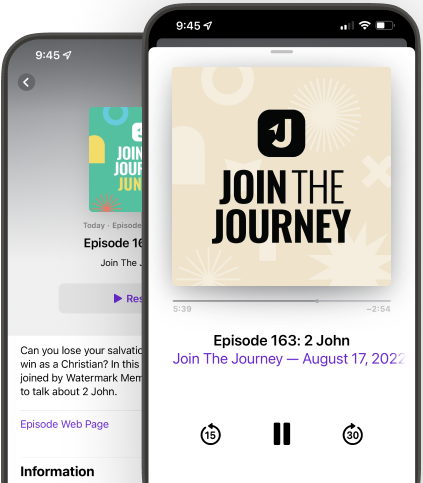
Watch or listen to the podcast
Tuesdays and Wednesdays
Monthly memory verse
For if you live according to the flesh you will die, but if by the Spirit you put to death the deeds of the body, you will live. For all who are led by the Spirit of God are sons of God.