December 4, 2026
Trusting in God’s Plan
Genesis 6:18-21
Key Verse | Genesis 6:18
But I will establish my covenant with you, and you shall come into the ark, you, your sons, your wife, and your sons’ wives with you.
Today's Focus
Today’s Prayer Prompt
Thank God for providing a way to be saved through Jesus. Ask him to help you trust and obey his Word, even when you don't understand his plan.
Genesis 6:18-21
18 But I will establish my covenant with you, and you shall come into the ark, you, your sons, your wife, and your sons' wives with you. 19 And of every living thing of all flesh, you shall bring two of every sort into the ark to keep them alive with you. They shall be male and female. 20 Of the birds according to their kinds, and of the animals according to their kinds, of every creeping thing of the ground, according to its kind, two of every sort shall come in to you to keep them alive. 21 Also take with you every sort of food that is eaten, and store it up. It shall serve as food for you and for them.”
Table of Contents
Introduction to Genesis
Timeline

Author, Date, and Recipients
Traditionally, Moses is considered to have been the author of Genesis and the rest of the Pentateuch (see Num. 33:2; Deut. 31:24; John 5:46). Of course, Moses lived much later than the events of Genesis. Presumably, stories were passed down about those earlier events, and Moses brought them all together.
The first audience would have been the Israelites Moses led through the wilderness. For readers today, Genesis is an essential introduction to the rest of the Bible. It is rightly called the book of beginnings.
Theme
The theme of Genesis is creation, sin, and re-creation. God made the world very good, but first cursed it and then destroyed it in the flood because of man’s disobedience. The new world after the flood was also spoiled by human sin (ch. 11). God chose Abraham for a special purpose. Through his family, all nations would be blessed (12:1–3). God’s purpose will eventually be fulfilled through Abraham’s descendants (ch. 49).
Key Themes
- The Lord God commissions human beings to be his representatives on earth. They are to take care of the earth and govern the other creatures (1:1–2:25).
- Instead of acting as God’s representatives on earth, the first man and woman—Adam and Eve—listen to the serpent and follow his advice. Their disobedience has devastating results for all mankind and for the entire created world (3:1–24; 6:5–6).
- God graciously announces that Eve’s offspring will free humanity from the serpent’s control (3:15). Genesis then begins tracing the history of one family that will become the people of Israel. This family has a special relationship with God and will become a source of blessing to fallen humanity (12:1–3).
- As a result of Adam’s disobedience, his unique relationship with the ground degenerates, resulting in hard work and later in flood and famine. But the special family descending from Adam also brings relief from the difficulties (3:17–19; 5:29; 50:19–21).
- While Eve’s punishment centers on pain in bearing children (3:16), women play an essential role in continuing the unique family line. With God’s help, even barrenness is overcome (11:30; 21:1–7; 25:21; 38:1–30).
- The corruption of human nature causes families to be torn apart (4:1–16; 13:5–8; 25:22–23; 27:41–45; 37:2–35). Although Genesis shows the reality of family conflicts, individual members of the chosen family can also help resolve those conflicts (13:8–11; 33:1–11; 45:1–28; 50:15–21).
- The wicked are exiled from Eden and scattered throughout the earth (3:22–24; 4:12–16; 11:9), but God is kind to his chosen people and promises them a land of their own (12:1–2, 7; 15:7–21; 28:13–14; 50:24).
- God is prepared to destroy almost the entire human race because of its corruption (6:7, 11–12; 18:17–33), but he still wants his world to be populated by righteous people (1:28; 9:1; 15:1–5; 35:11).
Outline
- Primeval History (1:1–11:26)
- Patriarchal History (11:27–50:26)
- Terah’s descendants (11:27–25:18)
- Isaac’s descendants (25:19–37:1)
- Jacob’s descendants (37:2–50:26)
The Near East at the Time of Genesis
Fact: In the Beginning
In the Hebrew Bible, the title of Genesis is In the Beginning, the book’s first words. The English title is related to the Greek word genesis, which means “beginning.”
Fact: Genesis through Deuteronomy
Genesis through Deuteronomy are the foundation of the Bible. They introduce the key promises that show God’s purposes in history and prepare for the coming of Jesus Christ.
Fact: The Sadducees
The Sadducees were a small but powerful group of Jewish leaders who did not believe in the resurrection (12:18). This may have been because of their emphasis on the Pentateuch (Genesis–Deuteronomy), which does not seem to explicitly mention the resurrection. But Jesus showed them that the idea of resurrection can, in fact, be found in the Pentateuch (Mark 12:26–27).
Fact: All things were made through him
All things were made through him. John begins his Gospel in the same way that Genesis begins: with creation (1:1–5; Gen. 1:1). He reveals that Jesus, God’s Son, existed eternally with God the Father, and the whole creation was made through him (Col. 1:15–16; compare 1 Cor. 8:6).
Fact: As numerous as the stars
As numerous as the stars. As the book of Exodus begins, some 350 years have passed since the end of Genesis. The 70 Israelites who went to Egypt have grown into a great multitude. This fulfills God’s promise to multiply Abraham’s descendants and to make them a blessing to all the nations of the world (Gen. 12:1–3; 15:5).
The Near East at the Time of Genesis
c. 2000 B.C.
The book of Genesis describes events in the ancient Near East from the beginnings of civilization to the relocation of Jacob’s (Israel’s) family in Egypt. The stories of Genesis are set among some of the oldest nations in the world, including Egypt, Assyria, Babylonia, and Elam.

The Garden of Eden
Genesis describes the location of Eden in relation to the convergence of four rivers. While two of the rivers are unknown (the Pishon and the Gihon), the nearly universal identification of the other two rivers as the Tigris and the Euphrates suggests a possible location for Eden at either their northern or southern extremes.

The Generations of Genesis
| Primeval History (1:1–11:26) | |||
|---|---|---|---|
| Introduction | General heading | Specific heading | Section introduced |
| 2:4 | These are the generations of | the heavens and the earth | 2:4–4:26 |
| 5:1 | These are the generations of | Adam | 5:1–6:8 |
| 6:9 | These are the generations of | Noah | 6:9–9:29 |
| 10:1 | These are the generations of | the sons of Noah | 10:1–11:9 |
| 11:10 | These are the generations of | Shem | 11:10–26 |
| Patriarchal History (11:27–50:26) | |||
| 11:27 | These are the generations of | Terah | 11:27–25:11 |
| 25:12 | These are the generations of | Ishmael | 25:12–18 |
| 25:19 | These are the generations of | Isaac | 25:19–35:29 |
| 36:1, 9 | These are the generations of | Esau | 36:1–37:1 |
| 37:2 | These are the generations of | Jacob | 37:2–50:26 |
Noah
Noah was a righteous man who faithfully walked with God despite the wickedness of his generation. When God chose to destroy the earth because of its hopeless corruption, Noah alone found favor in his eyes. God instructed Noah to build an ark that would keep him and his family safe during the coming flood. Noah also took representative pairs of each kind of animal with him into the ark, to replenish the earth after the flood. God made a covenant with Noah, promising that he would never again destroy the earth with a flood. The NT calls Noah a “herald of righteousness” (2 Pet. 2:5). (Genesis 6:7–8)
Devotion
Picture a Christmas tree. You might see ornaments shaped like angels, stars, shepherds, or baby Jesus in a manger. But what about a giant boat filled with animals? That would be a pretty unusual Christmas ornament! After all, what does Noah’s ark have to do with the birth of Jesus? More than you might think. You see, the Christmas story didn’t begin in Bethlehem. It’s part of a much bigger story God had been telling for thousands of years.
The story of Noah and the ark began before Noah was born. Yesterday, we read about how Adam and Eve brought sin into the world when they rebelled against God. And sadly, Adam and Eve weren’t the only people prone to disobedience. Romans tells us that we all have sinned and fall short of the glory of God (Romans 3:23). So, as more and more people inhabited the earth, evil also continued to increase. God was grieved by the wickedness in the world and decided to wipe creation clean.
However, not everyone turned their backs on God and so he chose Noah and his family to play a very important role in the story. God called them to make a giant wooden ark and to fill it with all the animals they could muster. They were going to preserve God’s good creation. Even though this plan likely seemed foolish, Noah trusted in God. Through them, God saved his people and had them start over again. In Genesis 8:11, Noah sent out a dove that returned with an olive leaf, a sign of new life after the flood. Centuries later, the Holy Spirit came down on Jesus like a dove, announcing the new life God offers through his Son (Matthew 3:16).
When we look around today, it’s obvious that there is a lot of evil and wickedness in our world. It can be tempting to not honor God with the things we think, say, or do. We, like the people in Noah’s day, are sinners who want to do things our way. However, just as there was only one way for Noah and his family to be saved, Jesus is the only way we can be saved from the punishment, power, and presence of our sin. God will rescue us like he rescued Noah when we have faith, and trust in God, his Word, and his promises.
Questions
- Where are you having a hard time believing God has your best in mind? What wickedness or brokenness do you wish God would rescue you from?
- What is one area of your life where you need to trust God's plan, even if you don't understand it?
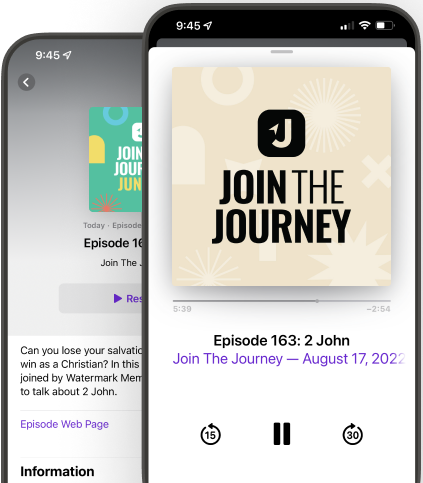
Watch or listen to the podcast
Tuesdays and Wednesdays
Monthly memory verse
For to us a child is born,
to us a son is given;
and the government shall be upon his shoulder,
and his name shall be called
Wonderful Counselor, Mighty God,
Everlasting Father, Prince of Peace.