December 2, 2026
Made in God’s Image
Genesis 1:26-28
Key Verse | Genesis 1:27
So God created man in his own image, in the image of God he created him; male and female he created them.
Today's Focus
Today’s Prayer Prompt
Praise God for his incredible creation! Thank him for creating you in his image and inviting you into a relationship with him.
Genesis 1:26-28
26 Then God said, “Let us make man 1 1:26 The Hebrew word for man (adam) is the generic term for mankind and becomes the proper name Adam in our image, after our likeness. And let them have dominion over the fish of the sea and over the birds of the heavens and over the livestock and over all the earth and over every creeping thing that creeps on the earth.”
27
So God created man in his own image,
in the image of God he created him;
male and female he created them.
28 And God blessed them. And God said to them, “Be fruitful and multiply and fill the earth and subdue it, and have dominion over the fish of the sea and over the birds of the heavens and over every living thing that moves on the earth.”
Footnotes
[1] 1:26 The Hebrew word for man (adam) is the generic term for mankind and becomes the proper name AdamTable of Contents
Introduction to Genesis
Timeline

Author, Date, and Recipients
Traditionally, Moses is considered to have been the author of Genesis and the rest of the Pentateuch (see Num. 33:2; Deut. 31:24; John 5:46). Of course, Moses lived much later than the events of Genesis. Presumably, stories were passed down about those earlier events, and Moses brought them all together.
The first audience would have been the Israelites Moses led through the wilderness. For readers today, Genesis is an essential introduction to the rest of the Bible. It is rightly called the book of beginnings.
Theme
The theme of Genesis is creation, sin, and re-creation. God made the world very good, but first cursed it and then destroyed it in the flood because of man’s disobedience. The new world after the flood was also spoiled by human sin (ch. 11). God chose Abraham for a special purpose. Through his family, all nations would be blessed (12:1–3). God’s purpose will eventually be fulfilled through Abraham’s descendants (ch. 49).
Key Themes
- The Lord God commissions human beings to be his representatives on earth. They are to take care of the earth and govern the other creatures (1:1–2:25).
- Instead of acting as God’s representatives on earth, the first man and woman—Adam and Eve—listen to the serpent and follow his advice. Their disobedience has devastating results for all mankind and for the entire created world (3:1–24; 6:5–6).
- God graciously announces that Eve’s offspring will free humanity from the serpent’s control (3:15). Genesis then begins tracing the history of one family that will become the people of Israel. This family has a special relationship with God and will become a source of blessing to fallen humanity (12:1–3).
- As a result of Adam’s disobedience, his unique relationship with the ground degenerates, resulting in hard work and later in flood and famine. But the special family descending from Adam also brings relief from the difficulties (3:17–19; 5:29; 50:19–21).
- While Eve’s punishment centers on pain in bearing children (3:16), women play an essential role in continuing the unique family line. With God’s help, even barrenness is overcome (11:30; 21:1–7; 25:21; 38:1–30).
- The corruption of human nature causes families to be torn apart (4:1–16; 13:5–8; 25:22–23; 27:41–45; 37:2–35). Although Genesis shows the reality of family conflicts, individual members of the chosen family can also help resolve those conflicts (13:8–11; 33:1–11; 45:1–28; 50:15–21).
- The wicked are exiled from Eden and scattered throughout the earth (3:22–24; 4:12–16; 11:9), but God is kind to his chosen people and promises them a land of their own (12:1–2, 7; 15:7–21; 28:13–14; 50:24).
- God is prepared to destroy almost the entire human race because of its corruption (6:7, 11–12; 18:17–33), but he still wants his world to be populated by righteous people (1:28; 9:1; 15:1–5; 35:11).
Outline
- Primeval History (1:1–11:26)
- Patriarchal History (11:27–50:26)
- Terah’s descendants (11:27–25:18)
- Isaac’s descendants (25:19–37:1)
- Jacob’s descendants (37:2–50:26)
The Near East at the Time of Genesis
Fact: In the Beginning
In the Hebrew Bible, the title of Genesis is In the Beginning, the book’s first words. The English title is related to the Greek word genesis, which means “beginning.”
Fact: Genesis through Deuteronomy
Genesis through Deuteronomy are the foundation of the Bible. They introduce the key promises that show God’s purposes in history and prepare for the coming of Jesus Christ.
Fact: The Sadducees
The Sadducees were a small but powerful group of Jewish leaders who did not believe in the resurrection (12:18). This may have been because of their emphasis on the Pentateuch (Genesis–Deuteronomy), which does not seem to explicitly mention the resurrection. But Jesus showed them that the idea of resurrection can, in fact, be found in the Pentateuch (Mark 12:26–27).
Fact: All things were made through him
All things were made through him. John begins his Gospel in the same way that Genesis begins: with creation (1:1–5; Gen. 1:1). He reveals that Jesus, God’s Son, existed eternally with God the Father, and the whole creation was made through him (Col. 1:15–16; compare 1 Cor. 8:6).
Fact: As numerous as the stars
As numerous as the stars. As the book of Exodus begins, some 350 years have passed since the end of Genesis. The 70 Israelites who went to Egypt have grown into a great multitude. This fulfills God’s promise to multiply Abraham’s descendants and to make them a blessing to all the nations of the world (Gen. 12:1–3; 15:5).
Fact: Father, Son, and Holy Spirit
Father, Son, and Holy Spirit. God said, “Let us make man” (1:26). This phrase could be the Bible’s earliest indication that God exists as three persons in one: Father, Son, and Holy Spirit. Christians around the world refer to this as the doctrine of the Trinity.
The Near East at the Time of Genesis
c. 2000 B.C.
The book of Genesis describes events in the ancient Near East from the beginnings of civilization to the relocation of Jacob’s (Israel’s) family in Egypt. The stories of Genesis are set among some of the oldest nations in the world, including Egypt, Assyria, Babylonia, and Elam.

The Garden of Eden
Genesis describes the location of Eden in relation to the convergence of four rivers. While two of the rivers are unknown (the Pishon and the Gihon), the nearly universal identification of the other two rivers as the Tigris and the Euphrates suggests a possible location for Eden at either their northern or southern extremes.

The Generations of Genesis
| Primeval History (1:1–11:26) | |||
|---|---|---|---|
| Introduction | General heading | Specific heading | Section introduced |
| 2:4 | These are the generations of | the heavens and the earth | 2:4–4:26 |
| 5:1 | These are the generations of | Adam | 5:1–6:8 |
| 6:9 | These are the generations of | Noah | 6:9–9:29 |
| 10:1 | These are the generations of | the sons of Noah | 10:1–11:9 |
| 11:10 | These are the generations of | Shem | 11:10–26 |
| Patriarchal History (11:27–50:26) | |||
| 11:27 | These are the generations of | Terah | 11:27–25:11 |
| 25:12 | These are the generations of | Ishmael | 25:12–18 |
| 25:19 | These are the generations of | Isaac | 25:19–35:29 |
| 36:1, 9 | These are the generations of | Esau | 36:1–37:1 |
| 37:2 | These are the generations of | Jacob | 37:2–50:26 |
The “Bookends” of Biblical Theology
God’s ultimate purpose in redemptive history is to create a people to dwell in his presence, glorifying him through numerous varied activities and enjoying him forever. The story begins with God in eternal glory, and it ends with God and his people in eternal glory. At the center stands the cross, where God revealed his glory through his Son.
The biblical story of redemption must be understood within the larger story of creation. First Adam, and later Israel, was placed in God’s sanctuary (the garden and the Promised Land, respectively), but both Adam and Israel failed to be a faithful, obedient steward, and both were expelled from the sanctuary God had created for them. But Jesus Christ—the second Adam, the son of Abraham, the son of David—was faithful and obedient to God. Though the world killed him, God raised him to life, which meant that death was defeated. Through his Spirit, God pours into sinners the resurrection life of his Son, creating a new humanity “in Christ.” Those who are “in Christ” move through death into new, re-embodied life and exaltation in God’s sanctuary, there to enjoy his presence forever.
The “bookends” concept of biblical theology illustrates that in the third-to-last chapter of the Bible (Revelation 20) God removes his enemies—Satan, death, and evil—that entered the story line in the third chapter of the Bible (Genesis 3), thus completing the story of redemption. The last two chapters (Revelation 21–22) don’t simply restore the first two chapters (Genesis 1–2); they go beyond them to a world that is fully ordered and holy, in which God is fully present with his people, completing the story of creation. (Chapter divisions in the Bible are, of course, human contributions, not divinely inspired.)

Gen. 1:26 Let us make man in our image. Some have suggested that God may be addressing the members of his heavenly court, whom the OT elsewhere calls “sons of God” (e.g., Job 1:6) and the NT calls “angels.” But man is not made in the image of angels (see Gen. 1:27), and the Bible never teaches that angels participated in the creation of human beings. Since God alone creates man (v. 27), many Christians believe that “let us” means God is speaking to himself. If so, this would be the first biblical mention of the “Trinity” (see note on John 1:1).
Fact: Father, Son, and Holy Spirit
Father, Son, and Holy Spirit. God said, “Let us make man” (1:26). This phrase could be the Bible’s earliest indication that God exists as three persons in one: Father, Son, and Holy Spirit. Christians around the world refer to this as the doctrine of the Trinity.
Gen. 1:27 The term image of God can be seen as describing the ways in which man is different from all other created beings. It describes how humans resemble God in their ability to think, to communicate, to understand right and wrong, to be creative, and to experience relationships with God and with one another. This allows men and women to represent God as they exercise authority over the rest of creation (see v. 26; and note on v. 28). The Hebrew word for man (’adam), is often a generic term for both male and female, though sometimes it refers to man in distinction from woman (e.g., 2:22, 23; 3:8). It can also be the proper name “Adam” (2:20; 3:17; 4:1; 5:1).
Gen. 1:28 Be fruitful and multiply. From the time of creation, God’s plan has been that the whole earth should be populated by those who know him and who serve wisely as his representatives. To subdue the earth and to have dominion over it probably means that humans are permitted to make the earth beneficial for themselves. They are to investigate and develop its resources. This command provides a basis for wise scientific and technological development. It does not mean that humans may exploit the earth and its creatures simply to satisfy their own greed.
Devotion
Did you know that the story of Christmas begins on the very first page of Genesis? “In the beginning, God created the heavens and the earth.” Right from the start, the Holy Spirit was hovering over the waters as God prepared to bring life into the world. In these first few sentences, we see God created the sun and the moon and the stars. He created the plants, the animals, and the fish in the sea. God spoke the whole world into existence, and then, on the sixth day he said, “Let us make man in our image.” “So, God created man in his own image, in the image of God he created him; male and female he created them.”
God created humanity to be like himself, or to “image” (reflect) him. One of the most amazing ways we get to do that is by being in relationship with him. Just as the Father delights in his relationship with the Son and the Spirit, we too get to delight in that community. While God did not need us, Genesis 1 and 2 shows us that he loves us and wants to be with us. God was pleased with his creation. “God saw everything that He had made, and behold, it was very good.” Note, it was only after creating humanity that God was finished with his work and rested.
Throughout the entire Bible you can see story after story of God pursuing a relationship with his people and it all began here “in the beginning.” Christmas reveals something extraordinary about God’s heart: He wants a relationship with us. As you keep reading this advent season, remember that God’s purpose for us is to bring glory to his name and be in a relationship with him. God loves the ones he created. He loves us so much that he even came to live with his people in his creation. So just wait until you see what happens next!
Questions
- Imagine for a moment what it would be like living in a world free from sin and death. What about this is most appealing to you?
- How can you remind yourself in the coming days that God is the creator of the whole world?
Optional: First time doing an Advent study? Check out this previous episode of The Join The Journey podcast: https://podcasts.apple.com/us/podcast/join-the-journey/id1600151923?i=1000637320650
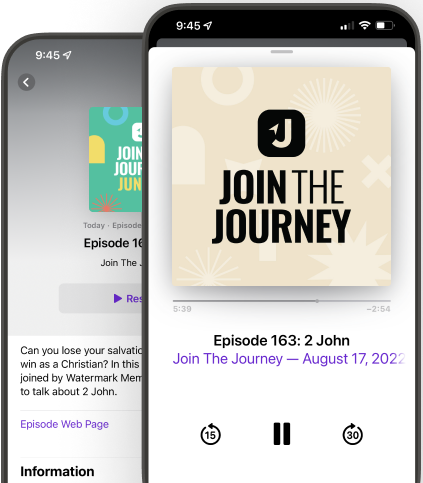
Watch or listen to the podcast
Tuesdays and Wednesdays
Monthly memory verse
For to us a child is born,
to us a son is given;
and the government shall be upon his shoulder,
and his name shall be called
Wonderful Counselor, Mighty God,
Everlasting Father, Prince of Peace.